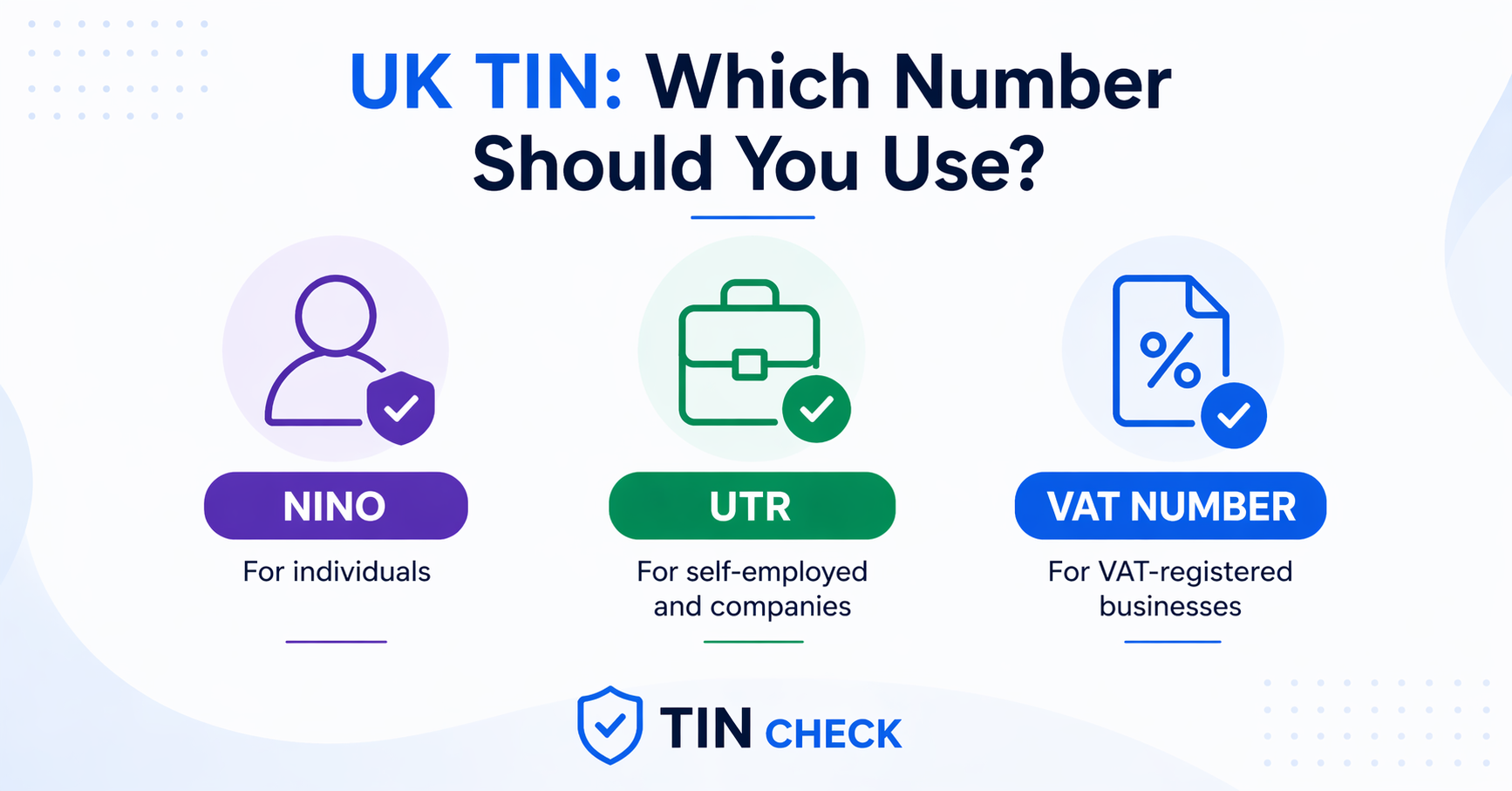
The United Kingdom does not assign a single Tax Identification Number (TIN)—unlike many other countries. This difference often leads to confusion, especially when completing international forms or complying with global tax regulations. Whether you're an individual, entrepreneur, or running a business, knowing which UK number to use as a TIN is essential for avoiding errors and maintaining compliance.
Why the UK Doesn’t Have a Single TIN
Unlike countries with a centralized tax identity system, the UK issues several different numbers to identify taxpayers for various purposes. Here are the most important ones:
- National Insurance Number (NINO) — Assigned to individuals for employment, personal tax, and social security.
- Unique Taxpayer Reference (UTR) — Assigned by HMRC to anyone registered for self-assessment tax: self-employed, freelancers, and companies.
- VAT Number — Issued to businesses and sole traders registered for Value-Added Tax (VAT).
- Company Registration Number (CRN) — Issued by Companies House upon company incorporation. Important: This is not a tax number, but is often requested for company verifications.
Which UK Tax Number Should You Use as a TIN?
The correct choice depends on your status and the context:
- Individuals: Use your National Insurance Number (NINO). Format: AB123456C.
This is widely accepted as the TIN equivalent for UK individuals. - Self-Employed Individuals: Use your Unique Taxpayer Reference (UTR). Format: 10-digit number issued by HMRC. Required for tax returns and self-assessment.
- Companies: Use your UTR as the primary tax identifier. Sometimes, forms may request your CRN for company authentication, but always prioritize your UTR when a tax number is required.
- VAT-Registered Entities: Provide your VAT Number (format: GB123456789) for cross-border trade, business invoices, and EU tax compliance.
What to Enter as a UK TIN on International Forms
Global banks, fintech platforms, digital marketplaces, and tax authorities (such as for CRS or FATCA) often require a TIN field. Here’s what you should provide:
- If you are an individual: NINO
- If you are operating as a business or company: UTR
- For VAT-related forms: VAT Number
Note: Some systems ask for 'TIN' as a universal field, even though the UK does not have one unique number. Make sure you select based on your type of entity and context.
Common Mistakes When Declaring a UK TIN
- Confusing the CRN (company registration) with the UTR (tax identifier).
- Entering a VAT number without the obligatory 'GB' prefix.
- Providing a NINO when representing a company, not as an individual.
- Supplying an incorrect UTR format (must be 10 digits).
Incorrect TIN selection can result in rejected forms, failed verifications, and compliance delays.
Can UK TINs Be Verified?
Not all UK tax identifiers are equally verifiable:
- NINO: Only basic format validation is possible; there is no public check.
- UTR: Issued by HMRC, not publicly searchable.
- VAT Number: Can be officially validated online using government systems.
This lack of universal verification adds to the importance of providing the correct number initially.
Summary: Quick-Reference Table
| Status | Tax Number to Use as TIN |
|---|---|
| Individual | NINO |
| Self-Employed | UTR |
| Company | UTR (primary), CRN (secondary) |
| VAT Transactions | VAT Number |
Validate Your UK TIN Before Submitting
Before completing any form, ensure your tax number is correct and well-formatted. Use trusted validation tools to reduce errors and keep your compliance efforts on track.
Conclusion: Context Is Everything
The UK’s multiple-tax-number approach is unique, but with clarity about your context, you can always provide the right identifier.
There is no universal UK TIN—only the right tax number for the right form.
Stay compliant by:
- Understanding which identifier suits your status
- Double-checking your entry before submitting
- Consulting validation tools or official guidance as needed
Need help? Try our UK TIN validation tool, or visit our comprehensive UK tax guide for detailed advice.