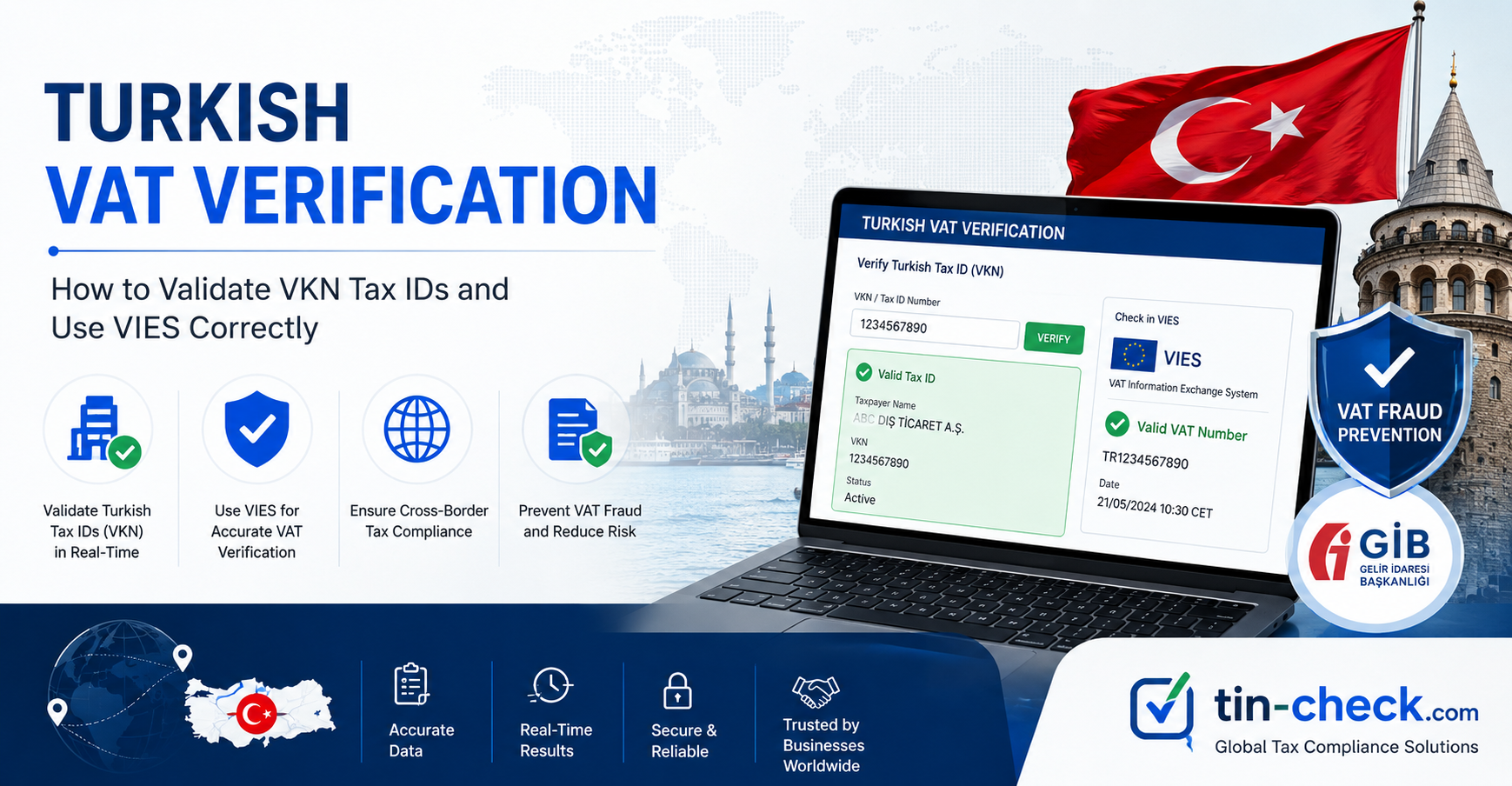
Turkish VAT Verification: How to Validate VKN, GİB Records and VIES Limits
Turkish VAT verification is the process of confirming whether a Turkish company’s tax identity is genuine, active and consistent with the legal entity you are onboarding, invoicing or paying. In Turkey, the key business tax identifier is the Vergi Kimlik Numarası (VKN), a 10-digit Tax Identification Number issued by the Turkish Revenue Administration, known as Gelir İdaresi Başkanlığı (GİB).
Quick answer: Turkish company VAT numbers are generally verified through Turkish national sources such as GİB and company registry records, not through the EU VIES database. VIES is used to validate VAT numbers from EU member states; Turkey is not an EU member state and Turkish VKNs are not standard VIES VAT numbers. Use VIES when your Turkish transaction involves an EU counterparty, and use Turkish national records to validate the Turkish company itself.
This guide explains how to validate a Turkish company Tax ID, when a VIES VAT check is relevant, what the VKN format looks like, and how finance, procurement, compliance and onboarding teams can reduce VAT fraud and cross-border tax risk.
Key Takeaways for Turkish VAT Verification
- Turkish companies use a 10-digit VKN for tax registration, invoicing and VAT-related administration.
- Turkey’s VAT is called KDV (Katma Değer Vergisi), and company VAT registration is linked to Turkish tax registration records.
- VIES does not validate Turkish VKNs as EU VAT numbers. It is useful for checking EU counterparties in transactions involving Turkey and the EU.
- GİB records and Turkish registry information should be used together for stronger due diligence.
- A valid-looking number is not enough. Match the VKN against the legal name, tax office, address, invoice details, contract data and bank account ownership where possible.
What Is a Turkish Tax Identification Number (VKN)?
The Turkish Tax Identification Number, or Vergi Kimlik Numarası (VKN), is the main tax identifier assigned to legal entities and many taxable persons in Turkey. For companies, it is typically a 10-digit numeric identifier used in tax filings, e-invoicing, official correspondence, supplier onboarding, customer due diligence and commercial documentation.
| Identifier | Used by | Typical format | Primary use |
|---|---|---|---|
| VKN | Companies and legal entities | 10 digits | Corporate tax, VAT/KDV registration, invoicing and tax administration |
| TCKN | Individuals | 11 digits | Personal identification and tax-related procedures for individuals |
| KDV registration | VAT-registered businesses | Linked to tax registration | Turkish VAT reporting and invoicing obligations |
In international business documents, a Turkish tax number may sometimes be written with a country prefix such as TR before the 10-digit VKN. However, that formatting does not make it an EU VIES VAT number.
Can You Verify a Turkish VAT Number on VIES?
No. A Turkish VKN is not normally verifiable through VIES because Turkey is not part of the EU VAT Information Exchange System. The official European Commission VIES VAT validation service is designed for checking VAT numbers issued by EU member states, plus specific EU VAT arrangements such as Northern Ireland for certain goods transactions.
VIES is still useful in Turkey-related trade when one party is established in the EU. For example, if a Turkish company sells to or buys from a German, French, Dutch or Polish VAT-registered business, you can use VIES to validate the EU counterparty’s VAT number. For the Turkish party, use Turkish national verification sources instead.
How to Verify a Turkish Company VKN: Step-by-Step
Use the following workflow for practical Tax ID validation in Turkey. It is suitable for supplier onboarding, customer due diligence, invoice checks, sanctions-adjacent screening, fraud prevention and finance controls.
1. Collect the company’s official tax details
Before running any lookup, request the company’s official details in writing. At minimum, collect:
- Registered legal name in Turkish and, if applicable, English trade name
- 10-digit VKN
- Tax office name
- Registered address
- Trade registry number or MERSİS number, if available
- Sample invoice or e-invoice details
- Contracting entity name and bank account information
Do not rely only on a website footer, email signature or proforma invoice. Fraudulent suppliers often use real company names with altered bank details or incorrect tax numbers.
2. Check the VKN format
A Turkish company VKN should generally be 10 digits. Remove spaces, punctuation and prefixes before checking the core number. If the number has 11 digits, it may be a personal Turkish identification number rather than a company VKN.
A format check is only the first layer of validation. A number can have the correct length and still be inactive, mismatched or misused.
3. Use official GİB resources where available
The primary authority for Turkish tax registration is Gelir İdaresi Başkanlığı (GİB), the Turkish Revenue Administration. Depending on the service available at the time of checking, GİB and connected e-government services may allow taxpayer, tax office or tax registration inquiries.
When using GİB-related services, compare the returned information with the documents supplied by the company. Confirm whether the name, VKN, tax office and status are consistent. If access to a specific query tool is restricted, unavailable or requires local credentials, request an official tax registration certificate from the counterparty or involve a Turkish accountant, lawyer or tax adviser.
4. Cross-check legal existence in trade registry records
Tax registration should be matched with legal existence. For corporate due diligence, also review Turkish company registry information, including the Turkish Trade Registry Gazette where relevant. Registry records can help confirm company formation, registered address, authorized representatives, capital changes, branch records and legal status updates.
This step is especially important for higher-risk transactions, first-time suppliers, large prepayments, export/import contracts and cases where the invoice name differs slightly from the contracting party.
5. Use VIES only for EU VAT numbers in the transaction
If the Turkish company is dealing with an EU business, validate the EU business’s VAT number through VIES. Select the EU member state that issued the VAT number, enter the VAT number without unnecessary spaces, and save evidence of the result for your audit file.
For example, if a Turkish company is invoicing a Polish VAT-registered customer, VIES can help verify the Polish VAT number. For more context on EU VAT validation workflows, see this related guide on company VAT verification in Poland using VIES.
6. Keep an audit trail
Record the date, time, source, search input, result and reviewer. Keep screenshots or downloaded confirmations where permitted. A strong audit trail helps demonstrate that your company performed reasonable due diligence if a tax authority, auditor, payment provider or compliance team later questions the transaction.
Turkish VAT Verification Checklist
Use this checklist before approving a Turkish company as a customer, supplier or invoice recipient:
- Confirm the VKN is 10 digits and belongs to the legal entity you are dealing with.
- Match the VKN to the registered legal name, not only the brand name.
- Check the tax office and address against official or documentary evidence.
- Review Turkish registry records for legal existence and authorized representatives.
- Validate any EU counterparty VAT number through VIES when the transaction involves the EU.
- Compare invoice details with contract details and purchase order records.
- Verify bank account ownership for high-value or first-time payments.
- Escalate mismatches to a Turkish tax professional before paying or applying VAT treatment.
For a focused country-specific walkthrough, you can also read our 2026 guide to verifying Turkish VAT numbers and Tax IDs.
Common Red Flags in Turkish Company Tax ID Validation
Pause the transaction and investigate further if you see any of the following issues:
- The VKN has the wrong number of digits or contains unexplained letters.
- The legal name on the invoice does not match the contract or tax record.
- The company requests payment to a bank account in a different name or country without a clear explanation.
- The counterparty claims a VAT exemption but cannot provide supporting documentation.
- The business is newly incorporated but requests unusually large upfront payments.
- The website, invoice and registry address show inconsistent contact details.
- The company provides only a TR-prefixed number and insists it is VIES-verifiable.
Best Practices for Cross-Border Tax Compliance with Turkish Companies
Combine tax, registry and payment checks
Effective company VAT verification is not a single database lookup. Combine VKN validation, GİB-related checks, trade registry review, invoice matching and bank account controls. This layered approach reduces exposure to VAT fraud, impersonation fraud and payment diversion.
Define when manual review is required
Create internal thresholds for manual review. For example, require compliance or finance approval when a Turkish counterparty is new, the transaction value is high, documents conflict, bank details change, or the VAT treatment affects tax reporting in more than one jurisdiction.
Use local expertise for complex VAT treatment
Turkish VAT rules, exemptions, reverse-charge analysis, import VAT, export documentation and permanent establishment questions can be complex. For material transactions, consult a qualified Turkish tax adviser or legal professional. This article provides general compliance information and is not tax or legal advice.
FAQ: Turkish VAT Verification and VKN Validation
Can I verify Turkish VAT numbers on VIES?
No. Turkish VKNs are not standard EU VIES VAT numbers because Turkey is not part of the EU VAT Information Exchange System. Use VIES to validate EU counterparties and Turkish national sources such as GİB-related records to validate Turkish companies.
What is the format of a Turkish company Tax Identification Number?
A Turkish company Tax Identification Number, known as a VKN, is generally a 10-digit numeric identifier. Individuals may have an 11-digit TCKN, which is different from a company VKN.
Is a Turkish VKN the same as a VAT number?
For companies, the VKN is the main tax identifier used for Turkish tax and VAT/KDV administration. Turkey does not use the same EU VAT number structure as EU member states, even if the number is sometimes written internationally with a TR prefix.
Where should I check a Turkish company tax number?
Start with official Turkish tax sources such as GİB and, where relevant, cross-check the legal entity through Turkish trade registry records. If online access is limited or the transaction is high risk, request official documents or use a Turkish tax adviser.
What should I do if the VKN is valid but the company name does not match?
Do not approve the transaction automatically. Ask the counterparty to explain the mismatch, provide updated official documents and confirm the contracting entity. Name mismatches can result from branch structures, trade names or harmless spelling differences, but they can also indicate fraud or invoicing errors.
Are Turkish VAT verification checks free?
Many official lookup and public registry resources are free to access, although some services may require local authentication, Turkish-language navigation or professional assistance. Paid verification tools may add workflow, monitoring and audit-trail features, but official records should remain the source of truth.
Conclusion
Reliable Turkish VAT verification depends on understanding the difference between Turkey’s national tax system and the EU VIES framework. For a Turkish company, focus on the 10-digit VKN, GİB-related tax records, registry information and document consistency. Use VIES only when validating an EU VAT number connected to the transaction.
By combining official tax checks, trade registry review, invoice matching and documented approval controls, businesses can reduce VAT fraud risk, improve cross-border tax compliance and make safer decisions when working with Turkish companies.