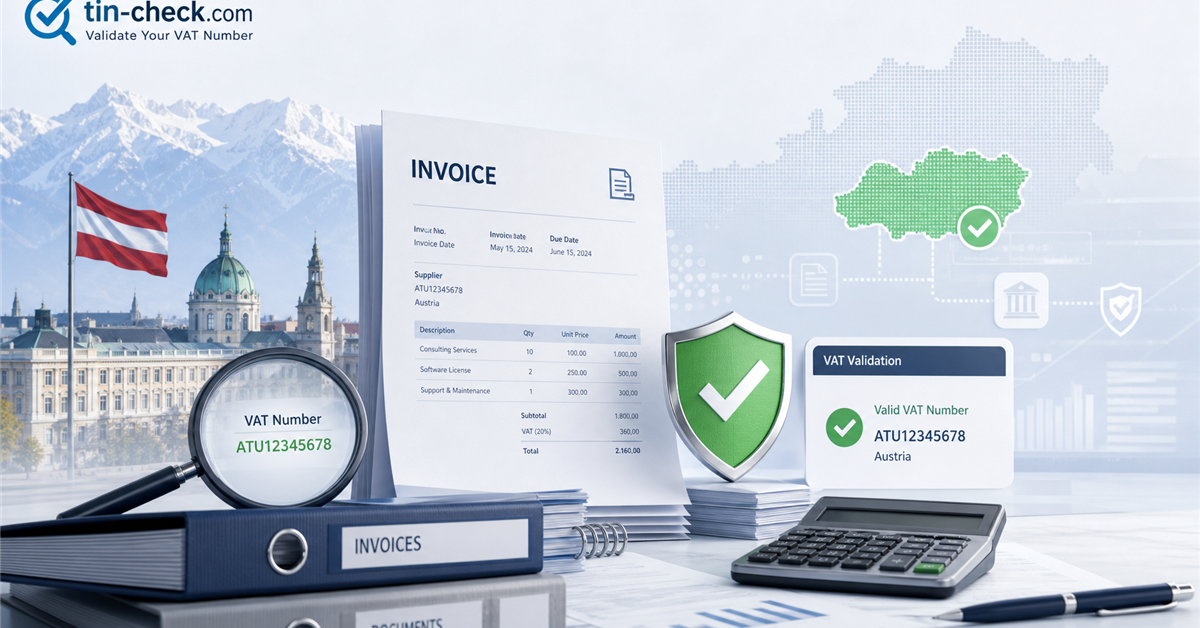
How to Validate Austrian VAT Numbers (Step-by-Step Guide for Businesses)
Last Updated: May 2026
Reviewed by: EU VAT Compliance Specialist
Austrian businesses must validate VAT numbers to comply with EU VAT regulations, reduce fraud risks, and ensure accurate invoice processing. This guide explains how to validate Austrian VAT numbers using VIES and FinanzOnline, automate VAT checks, and improve compliance workflows.
Key Takeaways
- Austrian VAT numbers start with ATU followed by 8 digits.
- Businesses can validate VAT numbers using VIES or FinanzOnline.
- VAT validation supports EU VAT compliance and fraud prevention.
- Automated VAT checks reduce invoice processing risks and manual work.
- Companies should store VAT validation proof for audit purposes.
Table of Contents
- What Is Austrian VAT Number Validation?
- Austrian VAT Number Format
- How to Validate Austrian VAT Numbers
- VIES vs FinanzOnline
- Who Should Automate VAT Validation?
- Why Austrian VAT Numbers Become Invalid
- Austrian VAT Validation Workflow
- VAT Compliance Best Practices
- FAQ
What Is Austrian VAT Number Validation?
An Austrian VAT number is a tax identification number assigned to VAT-registered businesses in Austria for tax reporting, invoice processing, supplier verification, and EU cross-border transactions.
VAT number validation is the process of checking whether a VAT registration is active and officially recognized by EU tax authorities.
For Austrian companies, VAT validation is an important part of:
- EU VAT compliance
- Supplier onboarding
- Invoice workflow controls
- Reverse charge VAT procedures
- Tax audit preparation
- Fraud prevention processes
According to the European Commission, VAT fraud and VAT compliance gaps continue to cost EU member states billions of euros annually, making VAT validation an essential financial control mechanism for businesses operating in intra-community trade.
Austrian VAT validation requirements are similar to those used in Germany, France, Italy, and other EU member states, although local tax verification systems may differ.
Step 1: Understand the Austrian VAT Number Format

Before validating a VAT number, verify that it follows the official Austrian VAT format.
A valid Austrian VAT number includes:
- Country code: AT
- The letter: U
- 8 numeric digits
Example: ATU12345678
Common Austrian VAT Number Formatting Errors
- Missing the letter U
- Incorrect digit count
- Wrong country prefix
- Extra spaces or symbols
- Invoice data entry mistakes
Even small formatting mistakes can cause VAT validation failures and invoice processing delays.
Step 2: Collect the VAT Number from the Invoice
The VAT number is usually displayed:
- In the invoice header
- Near supplier registration details
- Inside tax information sections
- In the invoice footer
Always copy the VAT number exactly as shown on the invoice before starting the validation process.
Step 3: Validate Austrian VAT Numbers Using VIES
The VAT Information Exchange System (VIES) is the official VAT validation platform provided by the European Commission.

How to Validate Austrian VAT Numbers in VIES
- Open the VIES VAT validation website.
- Select Austria (AT).
- Enter the VAT number without the AT prefix.
- Click Verify.
Example: enter U12345678 instead of ATU12345678.
VIES Validation Results
- Valid: The VAT number is active and registered.
- Invalid: The VAT number is inactive or unrecognized.
If a VAT number appears invalid, businesses should contact the supplier before processing the invoice or claiming VAT deductions.
Some Austrian companies experience temporary VAT verification failures during weekends or maintenance periods when VIES synchronization is delayed. In these situations, businesses should document the validation attempt and retry later.
Step 4: Validate VAT Numbers via FinanzOnline
FinanzOnline is the Austrian Federal Ministry of Finance platform used for domestic tax administration and VAT-related services.
How to Use FinanzOnline for VAT Verification
- Log in with your business credentials.
- Navigate to VAT-related services.
- Open the VAT verification tools.
- Check supplier or customer VAT registration status.
FinanzOnline may provide more detailed Austrian VAT registration information than VIES for domestic suppliers and local tax verification processes.
VIES vs FinanzOnline: Which VAT Validation Method Is Better?
| Validation Method | Best For | Coverage | Cost |
|---|---|---|---|
| VIES | EU cross-border VAT checks | All EU member states | Free |
| FinanzOnline | Domestic Austrian VAT verification | Austria only | Free |
| VAT Validation APIs | Automation and ERP integration | EU and global checks | Paid |
Most Austrian businesses use both VIES and local tax verification methods as part of a broader VAT compliance workflow.
Who Should Automate Austrian VAT Validation?
Automated VAT validation is especially useful for:
- Accounting firms
- E-commerce businesses
- ERP-intensive companies
- Cross-border EU suppliers
- Finance departments handling large invoice volumes
- Shared service centers processing supplier invoices
Businesses validating hundreds of EU invoices monthly often automate VAT checks to reduce manual verification work, improve supplier onboarding, and strengthen audit readiness.
Companies using ERP systems and automated invoice workflows can integrate VAT validation APIs directly into their compliance processes.
Best Tools for Austrian VAT Validation
- VIES VAT validation
- FinanzOnline verification tools
- ERP VAT validation modules
- Supplier onboarding systems
- Automated invoice compliance platforms
- Commercial VAT validation APIs
Businesses processing high invoice volumes can automate VAT checks with TIN Check to improve VAT compliance accuracy and reduce operational risk.
Why an Austrian VAT Number May Appear Invalid
- The company recently registered for VAT
- The business was deregistered
- The VAT number was entered incorrectly
- VIES synchronization delays occurred
- The supplier changed legal entity details
- The supplier provided outdated invoice information
If a VAT number fails validation unexpectedly, businesses should repeat the check later or confirm the VAT registration directly with the supplier or Austrian tax authorities.
Austrian VAT Validation Workflow Example
Supplier Invoice
↓
Check VAT Number Format
↓
Validate VAT Number in VIES
↓
Verify Supplier Details
↓
Store Validation Proof
↓
Approve Invoice
↓
Archive Audit Record
Maintaining a documented VAT audit trail helps Austrian businesses demonstrate due diligence during tax inspections and financial audits.
Real-World VAT Validation Challenges
Some Austrian businesses encounter temporary VAT validation failures shortly after a supplier registers for VAT because EU databases may not synchronize immediately.
In other cases, suppliers may change company names, legal structures, or VAT registration status without updating invoice templates immediately, creating discrepancies during invoice verification.
Documenting all validation attempts is considered good VAT compliance practice, especially when handling cross-border intra-community transactions.
Austrian VAT Validation Checklist
- Verify VAT number formatting
- Validate the VAT number in VIES
- Confirm supplier legitimacy
- Store VAT validation proof
- Revalidate suppliers periodically
- Maintain audit-ready compliance records
- Automate high-volume VAT checks
Best Practices for Austrian VAT Compliance
- Validate all supplier VAT numbers before onboarding
- Revalidate VAT numbers regularly
- Use automated invoice validation workflows
- Train accounting teams on VAT compliance procedures
- Monitor EU VAT regulation updates
- Maintain detailed VAT audit records
Why VAT Validation Matters for EU Cross-Border Transactions
Austrian businesses involved in intra-community trade must validate VAT registrations before applying reverse charge or zero-rated VAT treatment.
Incorrect VAT handling may result in:
- Denied VAT deductions
- Additional tax liabilities
- Regulatory penalties
- Delayed VAT refunds
- Tax audit investigations
Consistent VAT validation significantly reduces financial and compliance risks for Austrian businesses operating across the European Union.
Conclusion
Validating Austrian VAT numbers is an essential part of supplier verification, invoice processing, and EU VAT compliance.
By using VIES, FinanzOnline, and automated VAT validation workflows, Austrian businesses can reduce fraud exposure, improve operational efficiency, and strengthen tax compliance processes.
Businesses implementing automated VAT verification systems are generally better positioned for long-term compliance, audit readiness, and scalable invoice operations.
Frequently Asked Questions About Austrian VAT Validation
How do I verify an Austrian VAT number?
You can verify Austrian VAT numbers using the EU VIES platform or Austria’s FinanzOnline system.
What does an Austrian VAT number look like?
A valid Austrian VAT number starts with ATU followed by 8 digits, such as ATU12345678.
Why is my Austrian VAT number not working in VIES?
Possible reasons include delayed database synchronization, incorrect formatting, recent VAT registration, or inactive VAT status.
Can I deduct VAT from an invoice with an invalid VAT number?
Using invoices with invalid VAT numbers may create VAT deduction risks and compliance issues during tax audits.
How long does VAT registration activation take in Austria?
New VAT registrations may take time to appear in VIES because EU tax databases are not always synchronized instantly.
Do Austrian sole traders need VAT validation?
If the business is VAT registered and involved in taxable transactions, VAT validation procedures may still apply.
Is VAT validation mandatory in Austria?
VAT validation is required for many domestic and EU cross-border transactions involving VAT reporting and reverse charge rules.
Can Austrian VAT numbers become inactive?
Yes. VAT registrations may become inactive if a company closes, deregisters, or changes tax status.